
The "Panopticon": How a 200-Year-Old Prison Design Explains Your Digital Life (A Guide to Foucault).
NON-STOIC PHILOSOPHIES
1/23/20262 min read

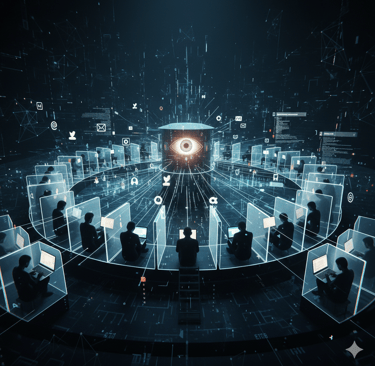
Imagine living in a prison where a single guard can watch every prisoner — but the prisoners never know when they’re being watched. This was the idea behind the Panopticon, an 18th-century prison design created by philosopher Jeremy Bentham.
But what if this centuries-old prison model explains something even bigger: how surveillance operates in today’s digital world?
Bentham’s Panopticon: The Architecture of Control
The Panopticon was designed as a circular building with cells arranged around a central tower. The guard inside the tower could observe every prisoner without being seen. This uncertainty — not knowing if you’re watched or not — compels inmates to regulate their own behavior, effectively "policing" themselves.
Bentham imagined this as an efficient way to encourage discipline and reform without harsh punishment or many guards.
Foucault’s Expansion: The Panopticon as a Metaphor for Society
Two centuries later, French philosopher Michel Foucault used the Panopticon as a metaphor for modern society. He argued that, beyond prisons, many parts of life now function like Panopticons: schools, hospitals, workplaces, and especially digital spaces.
In these “disciplinary” systems, people internalize the idea that they might be watched at any moment, influencing how they behave and conform. Surveillance becomes a subtle but powerful form of social control — not by direct force, but by shaping how we think about ourselves.
Your Digital Life as a Modern Panopticon
Smartphones, social media, and the internet track what you do constantly. Algorithms monitor your clicks, purchases, and locations. Companies—and sometimes governments—can watch and analyze your behavior in real-time. Even if you don’t know exactly when you’re being watched, the knowledge that you might be under observation changes how you act online.
This leads to widespread self-censorship, curated personas, and fears about privacy, all hallmark effects of living inside a digital Panopticon.
Why Understanding the Panopticon Matters
Knowing how this model works empowers us to question who controls the “watchtowers” today, how much of our freedom is shaped by invisible surveillance, and what we can do to reclaim privacy and authentic behavior.
The Panopticon isn’t just about prisons — it’s about awareness in the age of digital power.
Final Thought
Bentham’s Panopticon reminds us that power isn’t always brute force—it’s often invisible eyes shaping how we live. Foucault’s insights help decode our modern digital world, encouraging mindfulness about privacy, control, and freedom in everyday life.
Waste no more time arguing about what a good man should be. Be one - Marcus Aurelius
We suffer more often in imagination than in reality - Seneca
Wealth consists not in having great possessions, but in having few wants - Epictetus